The Presence Effect
What changes inside veteran homes when someone walks through the door
By James Greer
President & Founder, Ride for Veterans, Inc.
Inside a veteran home, two residents can live in the same building, receive the same level of care, and follow nearly identical daily routines—yet experience entirely different lives.
The difference is often not medical. It isn’t the room. It isn’t the staff.
More often than not, it comes down to something much simpler:
Whether someone visits.
There is a growing body of research showing that social connection plays a measurable role in the health and well-being of older adults.¹ Organizations like the National Academies of Sciences, Engineering, and Medicine and the National Institute on Aging have identified social isolation as a serious health concern—one associated with depression, cognitive decline, and increased risk of premature death.²
Inside veteran homes, those findings carry a different weight.
Because the people living there are not just aging.
They are veterans.

A life once lived in service—now lived quietly, often out of view.
Walk into a veteran home and you’ll see structure. Meals are served. Medications are administered. Schedules are followed. On paper, everything is being done right.
But human beings are not built on routine alone.
Veterans who receive regular visitors—family, friends, or members of the community—often show something different. They are more engaged. More responsive. Conversations come easier. Stories come back. Meals are more likely to be finished. There is a visible shift in presence.
Research supports what staff and volunteers quietly observe: increased social interaction is associated with improved mood, reduced loneliness, and better overall quality of life.³
And then there are the others.
The ones who don’t get visitors.
There is no announcement when it happens. No designation. But over time, patterns form. Days become quieter. Conversations become shorter. Engagement fades. The television stays on a little longer. The room gets a little stiller.
Studies show that loneliness is common among nursing home residents, and that isolation is closely tied to declines in emotional and cognitive well-being.⁴
What makes that reality harder to ignore is who these residents are.
They are veterans—individuals who lived lives shaped by service, responsibility, and experiences most people will never be asked to carry. They served in places and situations that leave a lasting mark, long after the uniform is gone.
In many cases, they gave years of their lives—and in some ways, much more than that—in service to something larger than themselves.
And now, for some of them, the days pass without anyone walking through that door—at all.
During the COVID-19 pandemic, visitation in long-term care facilities was restricted across the country. For a period of time, that human connection disappeared almost entirely.
What followed was consistent across studies:
Increased loneliness.
Higher levels of depression.
Noticeable cognitive and emotional decline.⁵
When visitation returned, many of those indicators began to improve.
It wasn’t complicated.
It was presence.
There is another part of this story that deserves to be recognized.
The staff inside these homes.
Day after day, they care for the residents—but what they provide often goes far beyond care. They talk with them. Sit with them. Listen to the same stories more than once, and treat them like they are being heard for the first time.
They learn names, histories, and habits. They notice the small changes others might miss. They bring energy into rooms that would otherwise remain quiet.
In many cases, they become the social connection.
For some residents, they are the only one.
And they carry that responsibility whether anyone walks through that door—or doesn’t.
There is also a part of this that research doesn’t fully capture.
A visit does not have to be long to matter.
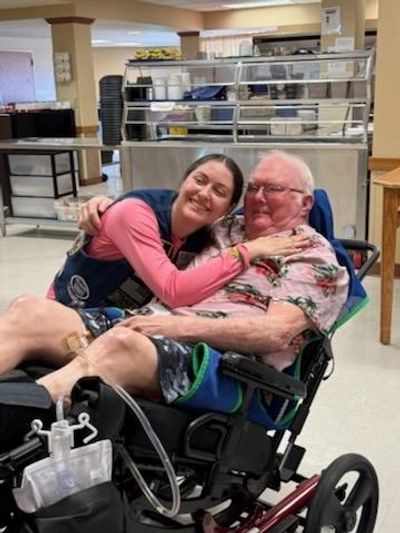
Sometimes it’s a conversation. A handshake. A few minutes of being seen and acknowledged. A reminder that someone took the time to show up.
Even brief moments can break the pattern of isolation. They bring energy into the room. They change the pace of the day. They remind someone that they are not forgotten.
The visit may be short.
But the impact is never forgotten.

Sometimes it’s as simple as a handshake—proof that someone showed up.
There is another part of this that often goes unseen.
This is why Ride for Veterans shows up.
We ride motorcycles. We drive cars. Some take the wheel, others ride in the passenger seat or follow along in the chase truck. However we get there, the purpose is the same—to walk through that door.
Every mile is traveled by choice. At our own expense. Time, fuel, and effort given freely, not because it is required, but because it matters.
Because for someone who has no one, the moment someone shows up—just to sit, to talk, to acknowledge them—carries weight.
It sends a message that doesn’t need to be explained:
You are not forgotten.
You matter.
What you did in your life still matters.
For someone who has no one, that moment is not small.
It’s everything.

Arrival matters. Presence changes the room before a word is even spoken.
There is another layer to this that is not always talked about.
The effect on the person who shows up.
Research has consistently shown that helping others is associated with improved mental health, reduced stress, and a greater sense of purpose.⁷ Acts of service—even brief ones—have been linked to measurable improvements in well-being and life satisfaction.⁸
Some studies have also found that individuals who regularly engage in helping behaviors experience lower rates of depression and, in some cases, improved longevity.⁹
But inside these homes, that isn’t something that needs to be explained.
It can be seen.
There is a shift that happens—not just in the resident, but in the person sitting across from them.
It is not always captured in data—but it is consistently observed.
The impact does not move in one direction.
What remains less clear is the question of longevity.
Research consistently shows that social isolation is associated with increased risk of premature death in older adults.⁶ What cannot yet be definitively proven is whether visitation alone directly extends life within a veteran home.
But that may not be the right question.
Because before longevity, there is something more immediate:
How that life is experienced.
Two veterans.
Same hallway.
Same level of care.
Same daily routine.
One has someone who walks through the door.
One does not.
The difference is not complicated.
It isn’t found in charts or schedules.
It’s found in presence.
I have seen the difference.
Not every visit changes a life in a way that can be measured.
But every visit changes someone.
Footnotes
1. Social connection and health outcomes in older adults are widely documented in public health and gerontology research.
2. National Academies of Sciences, Engineering, and Medicine (2020); National Institute on Aging (2021).
3. Holt-Lunstad et al. (2015).
4. Drageset, Kirkevold, & Espehaug (2013).
5. Simard & Volicer (2020).
6. Centers for Disease Control and Prevention (2023).
7. Mayo Clinic (2023).
8. Harvard Health Publishing (2020).
9. Post, S. G. (2005).
References Centers for Disease Control and Prevention. (2023). Social isolation and loneliness in older adults.
Drageset, J., Kirkevold, M., & Espehaug, B. (2013). Loneliness and social support among nursing home residents. Journal of Clinical Nursing, 22(1–2), 152–161.
Harvard Health Publishing. (2020). Giving and happiness.
Holt-Lunstad, J., Smith, T. B., Baker, M., Harris, T., & Stephenson, D. (2015). Loneliness and social isolation as risk factors for mortality. Perspectives on Psychological Science, 10(2), 227–237.
Mayo Clinic. (2023). Volunteering and its surprising benefits.
National Academies of Sciences, Engineering, and Medicine. (2020). Social isolation and loneliness in older adults.
National Institute on Aging. (2021). Social isolation, loneliness in older people pose health risks.
Post, S. G. (2005). Altruism, happiness, and health. International Journal of Behavioral Medicine, 12(2), 66–77.
Simard, J., & Volicer, L. (2020). Loneliness and isolation in long-term care. Journal of the American Medical Directors Association, 21(7), 966–967.
World Health Organization. (2021). Social isolation and loneliness among older people.
RIDE FOR VETERANS 2026
Walking through the door
The Ride Is Never About the Motorcycles... or the Cars

From left to right: Shawn Kirby, James Greer, Brandon Mitchel, and Mark Cox
People often ask us why we travel thousands of miles across America.
The answer isn't the motorcycles or the cars.
The answer is the people we travel to see.
Every stop reminds us why Ride for Veterans exists. It isn't about the miles. It isn't about the destination. It's about making sure our nation's aging veterans know they are remembered, appreciated, and never alone.
The People Behind the Mission
 Volunteers and Veterans Breaking Bread
"Who makes this mission possible."
Americans United by a Common Purpose
At first glance, this looks like a group of people sharing lunch.
But look a little closer.
You'll see two guests of honor whose service inspired everyone at the table.
You'll see people representing five different states, all willing to travel hundreds of miles for the same purpose.
You'll see three generations sitting side by side, proving that honoring veterans isn't limited by age.
You'll see four veterans and five civilians, reminding us that supporting those who served is a responsibility shared by all Americans.
Most importantly, you'll see Americans from every walk of life.
Different backgrounds. Different careers. Different generations. Different life experiences.
Yet around this one table, none of those differences matter.
What matters is a shared commitment to ensuring that those who served our nation are never forgotten.
Bringing People Together
 Every visit is about creating moments that bring people together.
Whether it's live music on the porch, conversations between volunteers and veterans, or simply enjoying the afternoon together, these gatherings create something special. For a little while, loneliness gives way to laughter, stories are shared, friendships are formed, and our nation's heroes are reminded that they are surrounded by people who genuinely care.
Sometimes the greatest gift we can offer isn't a program or a presentation.
It's simply showing up.
Every Story Matters

Sometimes the greatest gift we can give is our time. (Helen Cunningham) thank you
Our volunteers sat down with this incredible veteran and simply listened. There were no speeches or ceremonies—just genuine conversation, laughter, memories, and friendship. These moments remind us that many veterans don't need anything more than someone willing to spend time with them.
For us, that's time well spent.
A New Friend
 Every veteran has a story waiting to be heard.
Laura spent time getting to know one of our newest friends, learning about her life, her experiences, and sharing a few laughs along the way. It's amazing how quickly strangers become friends when someone simply takes the time to listen.
Helen Cunningham's Story
"Trying Not to Get in Trouble"
One of the highlights of our visit was listening to Helen Cunningham share a story from her time in Officer Candidate School—a story she admits has been told many times,
Thanks to the encouragement of one of the nurses who loves hearing it.
Helen wasn't just a veteran. She was a commissioned officer during a time when women in leadership roles were far less common than they are today. Earning that commission required determination, discipline, and the ability to succeed in an environment where female officers were still a rarity.
During Officer Candidate School, Helen and a few fellow cadets were finally granted a pass into town. After weeks of demanding training, everyone was excited to enjoy a little freedom.
But military training has a way of becoming second nature.
As they approached the entrance to a building, Helen noticed an Army officer walking out. He was the picture of military professionalism—dress blues pressed to perfection, gold shoulder cord, service cap, polished shoes, and every detail exactly as regulations required.
Without thinking, Helen snapped off a sharp, textbook-perfect salute.
The officer stopped.
He looked at the group of cadets for a moment, then quietly stepped aside and held the door open.
Helen walked through feeling an incredible sense of pride. Here was a senior male officer, showing what she believed was an extraordinary act of respect. At that time, gestures like that toward female officers weren't common, and she remembers feeling honored.
As she entered the building, one of her fellow cadets looked at her with a puzzled expression before breaking into laughter.
"Helen... what are you doing?"
Helen replied, completely serious,
"I'm trying not to get in trouble while we're on pass."
Her friend laughed even harder before delivering the line Helen has never forgotten:
"That's good... but you might want to stop saluting the doorman!"
The "officer" Helen had saluted wasn't an Army officer at all.
He was simply the doorman.
The room erupted in laughter as Helen finished the story, laughing right along with everyone else.
It was a reminder that some of life's best memories come from moments that don't go exactly as planned—and that even decades later, a good story shared with friends can still bring joy to everyone around the table.
That's what Ride for Veterans is all about—creating connections that remind our heroes they are still valued.
Memories That Never Fade One of the highlights of every visit is sharing the motorcycles.
As we looked over the patches, pins, and memories displayed on the bike, stories began to flow. Military service, family, places traveled, and moments that shaped a lifetime all came rushing back.
Sometimes a motorcycle—or a car—becomes more than transportation. It becomes the spark that unlocks memories and starts conversations that might never have happened otherwise.
Those conversations are priceless.
Every mile we travel has one purpose...
To remind America's veterans that they are not forgotten.
Whether we arrive on two wheels or four, our destination is always the same—bringing hope, friendship, and gratitude to those who have sacrificed so much for our freedom.
Thank you to everyone who supports James Greer's Ride for Veterans, Inc. Your encouragement, donations, and prayers make these visits possible.
One mile at a time. One veteran at a time.
Because no veteran should ever feel forgotten.